Everyone thinks you need a big ad budget to grow a business on social media. You don’t. Some of the fastest growing accounts on Instagram, TikTok and LinkedIn today have never run a single paid campaign. They have an organic social media marketing strategy instead.
The basic idea behind organic social media marketing is simple: grow your audience, engagement and ultimately your revenue, entirely through content, timing and strategy, without spending a dime on ads. This is not the same as paid marketing. It’s worth knowing the exact difference between the two before you build your approach.
Table of Contents
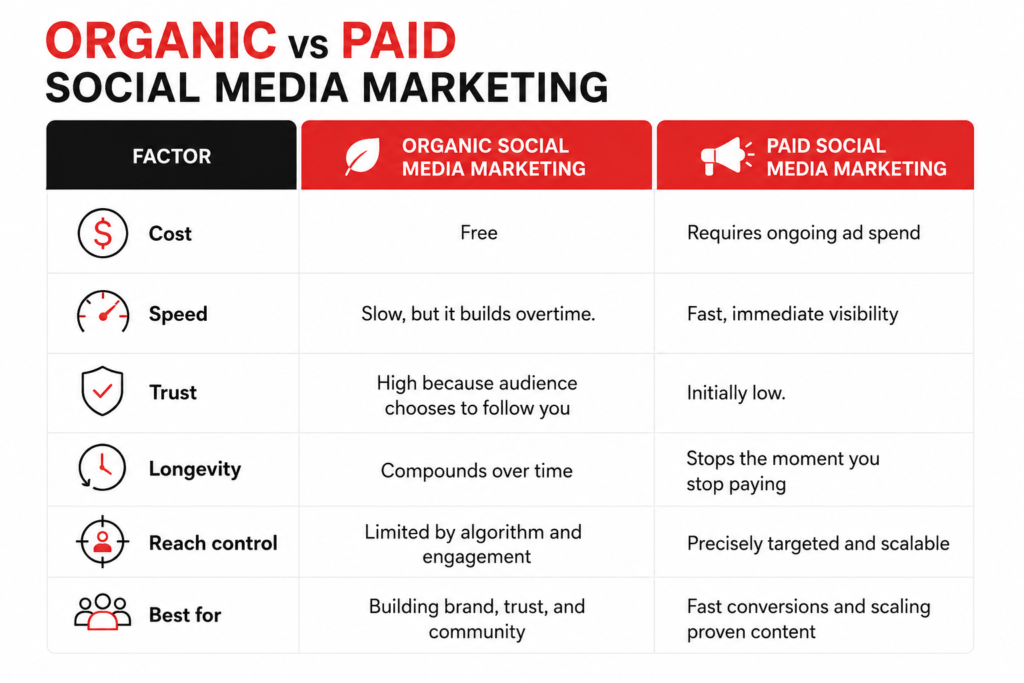
Neither one replaces the other. In fact, the businesses that grow fastest usually use organic content to figure out what actually works, then put money behind the content that’s already proven itself which we’ll come back to at the end of this guide.
This guide walks through every step of growing a business with organic social media marketing, so you can build a real strategy instead of just posting and hoping.
Step 1: Pick 1 or 2 Platforms to Do Organic Social Media Marketing
When you’re starting out with organic social media marketing, it’s overwhelming to try to grow on all the platforms at once and usually means doing all of them poorly instead of one or two really well. So get it down early.
But as a small business owner you neither have the time nor the resources to market your products or servvices on every platform.This usually means that choosing the right platform is more important than posting every where. And the only way you’ll know which is right is to know your target audience/ buyer persona – where are your potential customer actually spending their time.
- Target customer under 25? Instagram or TikTok usually works best.
- Target customer 30+? Facebook or X will tend to have more engagement.
- If you’re selling to business owners or B2B, LinkedIn is usually a better fit.
Choose the platform that’s right for your niche and customer avatar, not the one that’s trending right now. Once you’ve picked it, go deep. Try to learn as much as you can about that platform’s algorithm. Each platform is a little different in terms of what it rewards (watch time, saves, dwell time, shares) and getting those details right early on will save you months of posting content that was never going to do well there in the first place.
Step 2: Research, Research, Research
Research is your best friend when it comes to organic social media marketing. Most people skip this step and go straight to creating content — which is exactly why most people struggle to grow.
Here’s how to do it properly:
- Make a list of 5-10 of the best creators or businesses in your niche and adjacent niches. Some of them should be pretty established, but make sure you’ve got smaller, less popular accounts too.
- Review each profile and list out all the content formats they are using — Reels, carousels, talking-head videos, storytimes, whatever it is.
- Learn the patterns. What formats are repeated over and over again? Which ones are getting more engagement than the average for the account?
The aim’s not to copy anyone. It’s about seeing what formats already work for people in and around your niche, then you can replicate that structure with your own voice and ideas. This is especially true for the smaller accounts on your list.
If a format is working for a small creator with limited reach and no paid promotion, then that’s a sign that format works on its own merit, not because of an existing large following. That’s the kind of format you can realistically recreate and expect to work for you too.
Step 3: Divide Formats Into TOFU, MOFU, and BOFU
After you’ve consumed enough content, begin to categorize the formats you’ve found into three groups based on the section of the funnel they serve: TOFU, MOFU, and BOFU.
- TOFU (Top of Funnel) — content for people who don’t know who you are yet. Its role is to provide visibility and value, not sales. a Reel titled “3 Signs Your Skincare Routine Is Actually Damaging Your Skin” — broad, relatable, no pitch
- MOFU (Middle of Funnel) — content for those who follow you but are not customers yet. Its purpose is to develop trust and consideration. Example: “How I built my skincare routine around my skin type” – more personal, shows expertise, builds credibility.
- BOFU (Bottom of Funnel) — content aimed at people who are close to buying. Its job is to remove the last hesitation. Example: “Why I switched to this serum after years of breakouts” — testimonial-style, product-specific, direct.
A healthy content mix uses mostly TOFU content to grow reach, a steady stream of MOFU content to build trust, and just enough BOFU content to convert. The balance is what makes organic social media marketing work.
If you want to learn more about TOFU MOFU and BOFU and other content marketing funnelsthat can help you grow your business organically Read my Blog on Content Marketing Funnels.
Step 4: Study the Outlier Video Formats
In each niche, there will always be videos or posts that managed to go viral even though they were not a part of the average performance of the account. These outliers are the cheat codes in organic social media marketing.
Analyze the hooking components. Analyze the structure of the content. But then go one step ahead and write the complete transcript of the video into your AI chatbot and find out why it works. The ability to comprehend the mechanics behind things enables you to replicate them, and make them your own.
Here’s a prompt you can use for this exact process:
“Act as an experienced social media marketer and content strategist. I’m going to paste the transcript of a high-performing video below. Analyze it and break down: (1) the hook — what type it is and why it likely stopped the scroll, (2) the content structure — how the script is organized and paced, (3) the psychological or emotional triggers used throughout, (4) the call-to-action — how it’s phrased and why it works, and (5) 2-3 ways I could adapt this exact structure for my own niche without directly copying it. Here’s the transcript: [paste transcript]”
If you are a small business owner trying to grow on youtube, but you don’t know what to make videos about, Read this Blog to Learn the exact system you need to use to find outlier video ideas for Youtube that are almost guarenteed to go viral.
If you are a small business owner trying to grow on Instagran, but you don’t know what to make videos about, Read this Blog to Learn the exact system you need to use to find video ideas for Instagram that are almost guarenteed to go viral.
Step 5: Nail the Hook
The hook is the most important aspect in organic social media marketing. It’s the part of the content that decides whether people will actually want to watch the whole thing.
Visual Hook > Textual Hook > Verbal Hook
The most visually interesting content usually wins the race to interrupt the scroll. It is followed in effectiveness by the text and finally the verbal hooks. However, when it comes to creating the most successful content, all three hooks have to be combined. So what actually creates viral content?
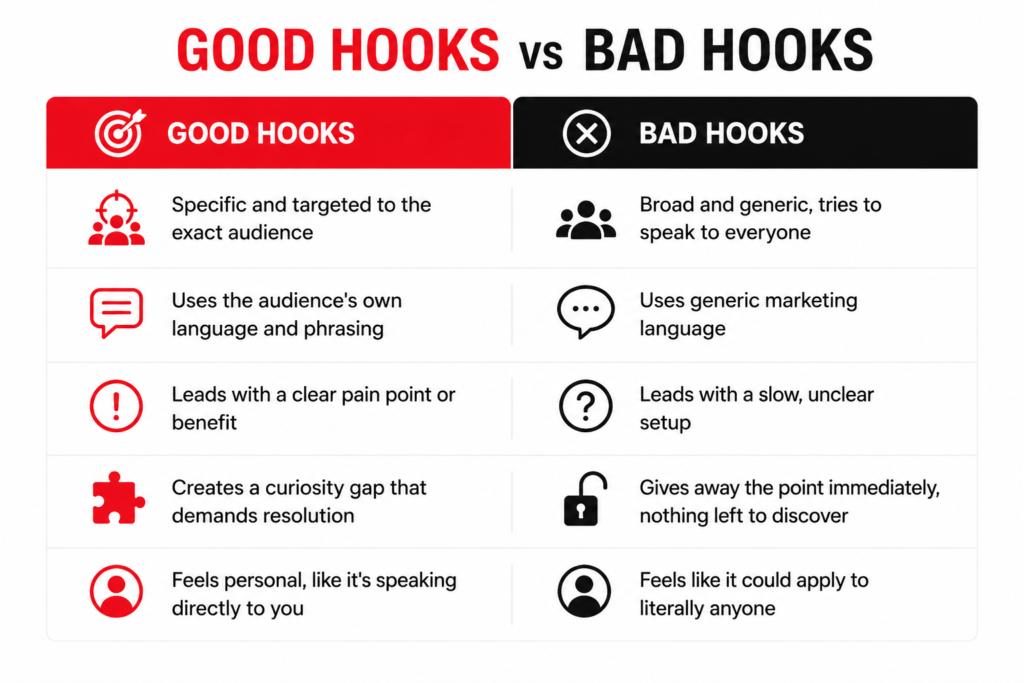
Read this If you want to know exactly how to write hooks that go viral on instagram through organic social media marketing.
Step 6: Create Storytelling Content
It truly is no exaggeration that storytelling material is the biggest gem for businesses looking for an organic social media marketing strategy right now. It always wins over promotional material because people do not pass on the storytelling material like they do promotional material – because it makes people feel invested emotionally, and feeling emotionally invested is how people become followers and customers.
The best script structure for that kind of material is called PAS: Problem, Agitate, Solution.
- Problem — name the exact problem your audience is dealing with, in their own words
- Agitate — dig into why that problem is more frustrating, costly, or urgent than they may have realized
- Solution — introduce your product, service, or insight as the clear way through it
Example: “You keep posting regularly, but your reach just doesn’t seem to be increasing.” (Problem) “But the problem is not about you having bad content, the problem is that your hook is driving people away within the first two seconds and then the algorithm is burying all the rest of it.” (Agitation) “Here are the exact steps you can take to solve this using three proven hook formulas.”
The reason why this structure works so effectively is that it aligns itself with the way people think about problems before they are ready for the solution.
Read this if you want other script structures that will help you in your organic social media marketing journey.
Step 7: Write CTAs That Actually Work
Generic CTA’s like “Buy now,” “Link in bio,” “DM me” etc don’t work in organic social media marketing. People have seen too much of them.
A successful CTA addresses the viewer’s need or desired result rather than giving the action instructions.
For instance, if you sell a massage gun, the “Buy now” CTA will not work. Try using “Get rid of your stress” CTA. It addresses the viewer’s need for the product’s effect right away.
Step 8: Do Regular Audits
Untracked growth is just educated form of guessing. If you want to grow with organic social media marketing you must conduct regular audits on whatever it is you are posting.
Here’s How to do it:
Firstly, figure out what your KPIs are: save rate, share rate, average viewing time, and engagement versus.Every big platform has its own analytic tool (Instagram Insights, TikTok Analytics, LinkedIn Analytics, etc.), but most creators dont know how to use them well. Use them fully. Figure out which of the formats you used works and which ones doesn’t.
Combining Organic Social Media Marketing with Paid Ads
After a while of sticking to this organic social media marketing strategy, you will definitely notice that some types of content work much better than all others that you publish. This is your cue.
Instead of experimenting with your guesswork and using paid ads for the random types of content or targeting, you can simply use the best-performing content organically — meaning that it gets unusually high rates of saves, shares, or other forms of interaction — and invest in this particular content with your ad budget.
Here the two types of social media marketing (Organic social media marketing and paid social media marketing) converge. This combination that always gives the highest ROI.
What’s next?
if you want to learn more about the exact strategies that will help you improve your marketing and grow your business click here. It’s free.