Creating a buyer persona is one of the first and foremost things you should consider doing in order to get success in both digital marketing and conventional marketing strategies. It becomes all the more necessary for you if you are marketing your business via social media marketing. It is essential for you to determine your target audience before writing any caption, choosing any platform, or spending any money on advertising.
Table of Contents
What’s the Difference Between a Target Audience and a Buyer Persona?
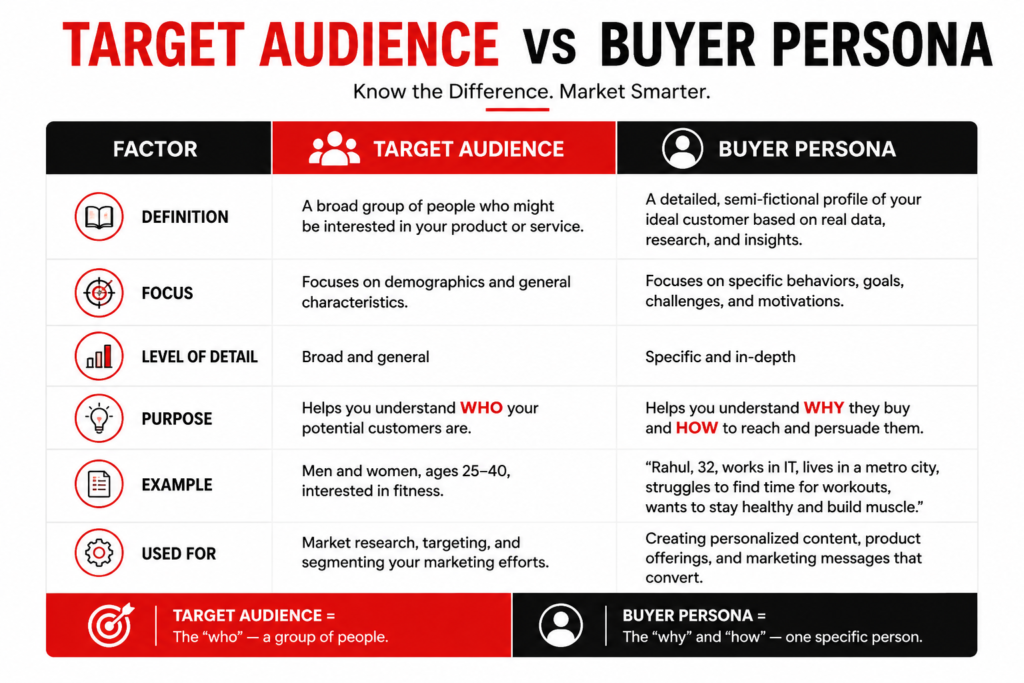
They are often used synonymously but they are not quite the same thing.
The target audience is a broad group of individuals who may be inclined towards your product offering. For instance, “women between 25 to 40 years of age interested in skincare products.” This represents a category and not an individual.
The buyer persona digs a bit deeper as it provides a highly descriptive and fictional profile of your ideal buyer along with the name of the individual, their lifestyle, pain points and goals.
Why a Buyer Persona Actually Matters
It’s quite easy to treat this asan optional step you skip to get to the fun part. But a clear buyer persona quietly shapes almost every decision you make afterward.
- Choosing a platform — the wrong platform choice can quietly kill your growth before you’ve even posted your first piece of content. I mean just think about it. If your ideal customer is a 45-year-old business owner, building your whole strategy around TikTok trends is a losing game from day one.
- Running ads — ad platforms like Google and Meta let you target with incredible precision, as long as you actually know who you’re targeting. If you dont have a buyer persona you are wasting money showing your ads to the wrong people.
- Organic social media marketing — every hook, caption, and content format performs better when it’s written for one specific person instead of an unknown crowd. Specificity is what makes people listen to you.
- Messaging and tone — how you write, what problems you address, even the language you use, all change depending on who’s actually on the other side of the screen.
- Product and offer decisions — understanding your persona’s real frustrations often reveals what to build or sell next, not just how to market what you already have.
As the old marketing saying goes: if you’re targeting everyone, you’re targeting no one.
The 4 Pillars of a Buyer Persona
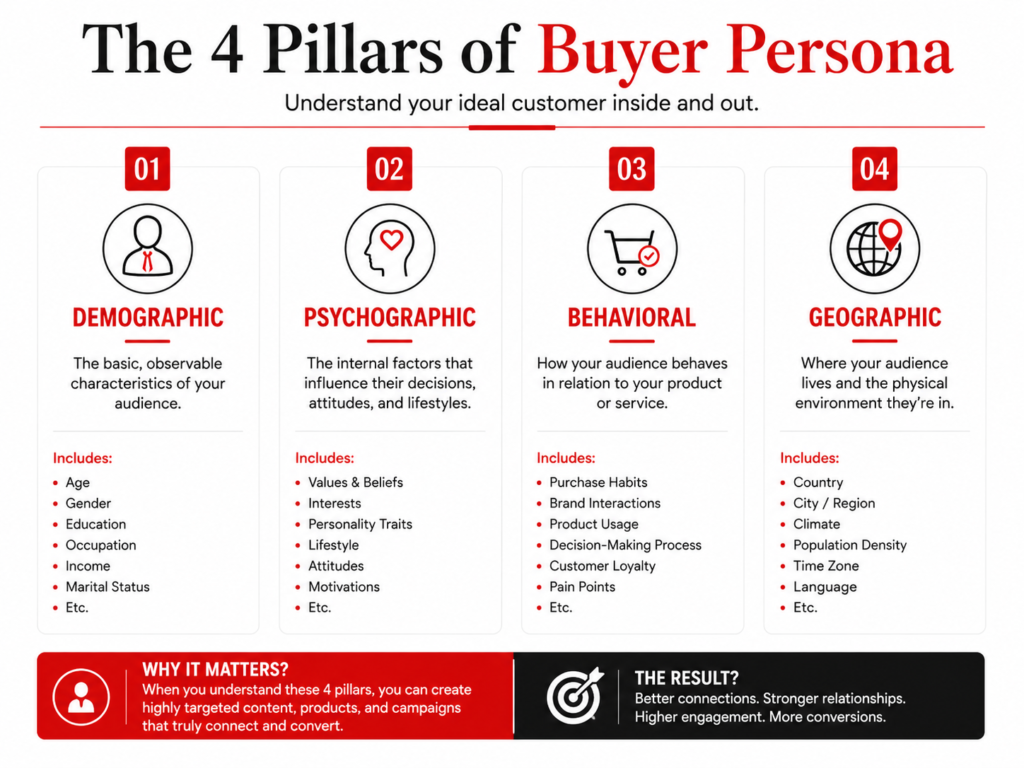
1. Demographic- This serves as the base for all the other pillars of buyer persona. It’s the basic, factual details that describe who your persona is on paper This is also the easiest to reasearch because there is a lot of information already out there on public platforms like reddit, twitter, or already existing customer data.
This pillar typically includes:
- Age range
- Gender
- Income level
- Education level
- Occupation or industry
- Family or relationship status
If you’re selling a premium service, knowing your ideal costumers income bracket tells you immediately whether your pricing make sense for them. If you skip this pillar, you will risk building an entire strategy around a price point or product angle your actual audience doesn’t care about.
Example – Duolingo: One potential customer persona for Duolingo could be someone who is between 16-24 years old, in school or just starting their careers, with limited discretionary income and a student or a young professional. This is enough to justify why the application adopted a freemium pricing strategy rather than premium-only subscription based pricing strategy.
2. Psychographics: This is where it gets genuinely interesting. Its also where most businesses stop. It covers the internal, less visible side of your persona: what they value, believe, and care about, separate from the external facts demographics capture. That’s why it’s one of the most impportant part of the buyer persona.
This pillar typically includes:
- Core values and beliefs
- Interests and hobbies
- Personality traits
- Lifestyle choices
- Attitudes toward money, status, or convenience
Two individuals could be identical in every demographic respect like their age, income, or occupation yet possess entirely differing interests and values. One person could be concerned with convenience and speed while the other individual could be concerned with sustainability and craftsmanship regardless of cost. Psychographics provide reasons for buying something rather than reasons for being who one is which is precisely why it influences tone more than any other pillar.
Example: Duolingo- In terms of Duolingo, the buyer persona values self-improvement, but at the same time, they can easily get distracted and procrastinate. In simple terms these are people who genuinely want to learn but have trouble sticking to the task (like me).
This one psychographic insight can explain most product decisions made by Duolingo like gamification, streaks, notification messages that make you feel bad for not doing it, and chunked content. The product was not designed for “people who want to learn Spanish” but for “people who want to learn Spanish but need to be tricked.“
3. Behavioral: This pillar looks at how your buyer persona actually behaves or what they do, especially when it comes to discovering, researching, and buying products like yours.
This pillar typically includes:
- Buying habits and purchase frequency
- Brand loyalty and switching behavior
- How they research before purchasing
- Preferred content formats and platforms
- How they interact with content — scrolling, saving, commenting, sharing
This pillar of buyer persona goes into deapth and asks questions like- are they impulse buyers who make their decision after watching a single Reel, or do they research for weeks and read product reviews before choosing? are they loyal to brands, or do they jump from one brand to another depending on cost or trend?
This pillar defines how hard you can sell or how much time you need to spend building the relationship before making a sales approach; for example, a buyer that conducts a lot of research requires trust-based content before being sold on anything.
Example – Duolingo: Their buyer persona downloads the app on a whim, often after seeing it referenced in a meme or a friend’s streak count, rather than after weeks of comparing language-learning apps. They open the app in short, frequent bursts, when ever they are bored, when ever they feel like it wether it is while waiting in line, on a commute, before bed, rather than sitting down for one long session. This behavioral pattern is exactly why Duolingo optimized for daily micro-engagement instead of long, infrequent study sessions.
4. Geographic This covers exact location of the buyer persona and it matters more than most people assume, especially especially for local or small scale businesses.
This pillar typically includes:
- Country and region
- City or urban vs. rural setting
- Climate and seasonal factors
- Local culture and language nuances
- Regional platform popularity
Geographical context plays a role in determining factors such as which language and cultural examples will be effective on the buyer persona, as well as on which social media platform they even have a significant reach in that particular location. For example, a buyer persona located in a metro area may be more suited to a faster, trendier style of content creation, whereas a smaller town may benefit from a more relaxed, community-based approach.
Example — Duolingo: Duolingo’s buyer persona exists globally. But it has heavy concentration of viewers in the US, India, Brazil, and other markets with strong English and Spanish learning demand. This is exactly why Duolingo localizes so aggressively. Different languages offered by region, culturally relevant memes and characters, and marketing tone that shifts depending on the market, rather than a single global campaign forced onto every country the same way.
How to Build A Complete Buyer Persona- Example: Duolingo
Lets use everything we learned so far to build a complete buyer persona for Duolingo.
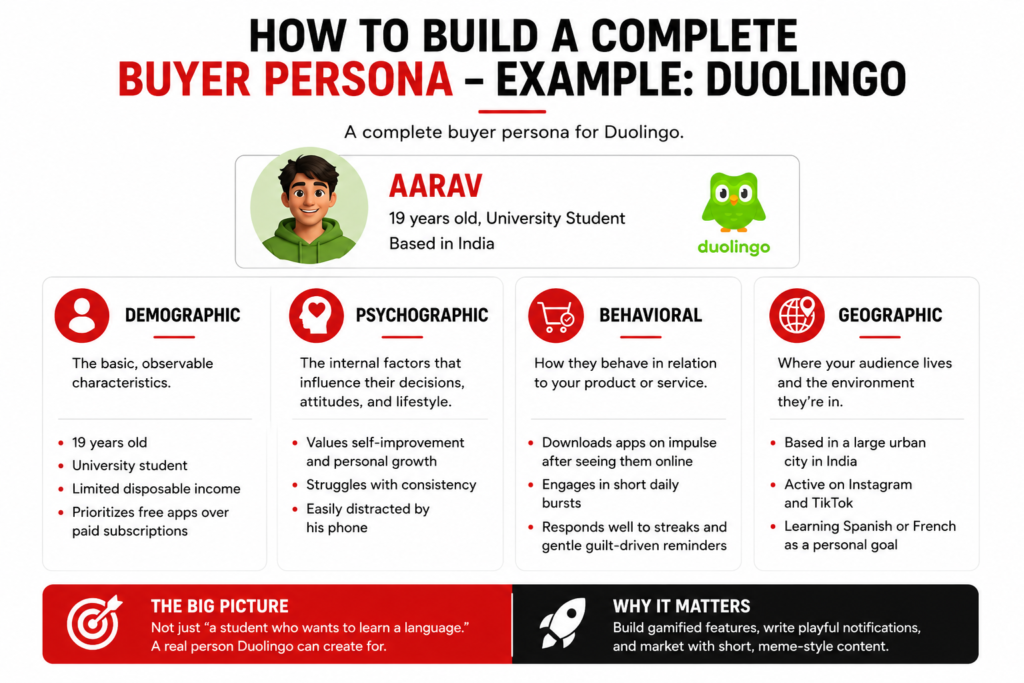
Meet “Aarav,” Duolingo’s core buyer persona:
- Demographic: 19 years old, university student, limited disposable income, using a free app is a priority over a paid subscription.
- Psychographic: Values self-improvement and personal growth, but struggles with consistency and is easily distracted by his phone.
- Behavioral: Downloads apps on impulse after seeing them mentioned online, engages in short daily bursts rather than long sessions, responds well to streaks and gentle guilt-driven reminders.
- Geographic: Based in a large urban city in India, primarily active on Instagram and TikTok, learning Spanish or French as a personal goal rather than for work.
Puting it all together, this isn’t just “a student who wants to learn a language.” It’s a specific person that Duolingo can build gamified features for, write playful notifications for, and market to with short, meme-style content instead of generic ads. That’s the entire point of building a buyer persona: turning a vague idea into someone specific enough to actually create for.
Using Your Buyer Persona to Choose the Right Platform
The first and most significant use of a buyer persona is picking the right platforms to build your marketing strategy around. And once your buyer persona is built out across all four pillars, platform selection stops being a guess and starts being a straightforward decision.
Demographic and geographic data narrow down which platforms even make sense, behavioral data tells you which content format will hold attention, and psychographic data shapes the tone once you’re there. Building the buyer persona first is what turns platform choice into a conclusion you arrive at, instead of a starting assumption.
What’s Next
Now that you understand who your audience is and which platform you should be marketing on, read this blog to learn exactly how to build a complete organic social media marketing strategy around that.
Go to my page to read how to improve your marketing and grow your business because just knowing about buyer persona isn’t going to help you get the maximum out of your business.