You post consistently, you try every trend, and you still get a handful of views, a few likes and almost no customers. It’s frustrating, and it leads to low growth, wasted hours and a growing feeling that social media just doesn’t work for your business.
Here’s the thing: the reason might not be that your content is bad. It might be that you don’t understand how a content marketing funnel works. This guide breaks it down in plain language, so your content finally lands with the right audience.
Table of Contents
What Is a Content Marketing Funnel?
The content marketing funnel is the journey that complete strangers make from seeing your content for the first time to being paying customers of your services. This is called a funnel since a number of people join at the top of it but very few make it to its bottom end.
The process does not involve making more content but the right type of content for the right audience at the right time. Every bit of the content you produce has just one job: move the viewer one step closer to buying.
Who Is a Content Marketing Funnel For?
A content marketing funnel is for anybody that sells something while relying on social media as a costume acquisition channel. It’s especially useful if you’re:
- An online coach or consultant selling programs or 1 on 1 services
- A small business owner trying to bring customers in through Instagram, TikTok or YouTube
- A freelancer or creator who gets views but not inquiries
- A service provider who posts often but rarely gets leads
If you’ve ever thought “people watch my content, so why don’t they buy?”, this is for you.
Why Do You Need a Content Marketing Funnel?
Without a content marketing funnel, you’re posting and hoping. You are just throwing random content into and algoritm and waiting for something to blow up. With a content marketing funnel, each and every one of your posts has a purpose.
The people who watch your content probably need what you sell, but most of them might not be ready to buy yet. The pupose of a content marketing funnel is to meet people where they are at, build trust and make the final sale feel like a natural and necessary step.
It also shows you exactly where you’re losing people. Low views, low saves and low sales each point to a different problem, and a funnel helps you find which one.
There are several types of content marketing funnels out there, including TOFU, MOFU and BOFU, the AIDA framework and the See, Think, Do, Care framework by Google. But to understand any of them, you first need to understand the different awareness stages.
What Are Awareness Stages?
Awareness stages describe how much a person already knows about their problem, the possible solutions for it, and your company when he/she comes across your content. An individual who is at the beginning stage of identifying his/her problem requires completely different content compared to one who is ready to purchase.
Having knowledge of your audience is not just a fancy gimmik; rather, it forms the basis of every content marketing funnel. Without knowing whom you are addressing, you will be unable to understand where he/she stands. In case you are not sure about your ideal customer yet, read this complete guide to creating your buyer persona.
The 5 Awareness Stages and the Content Each One Reacts To
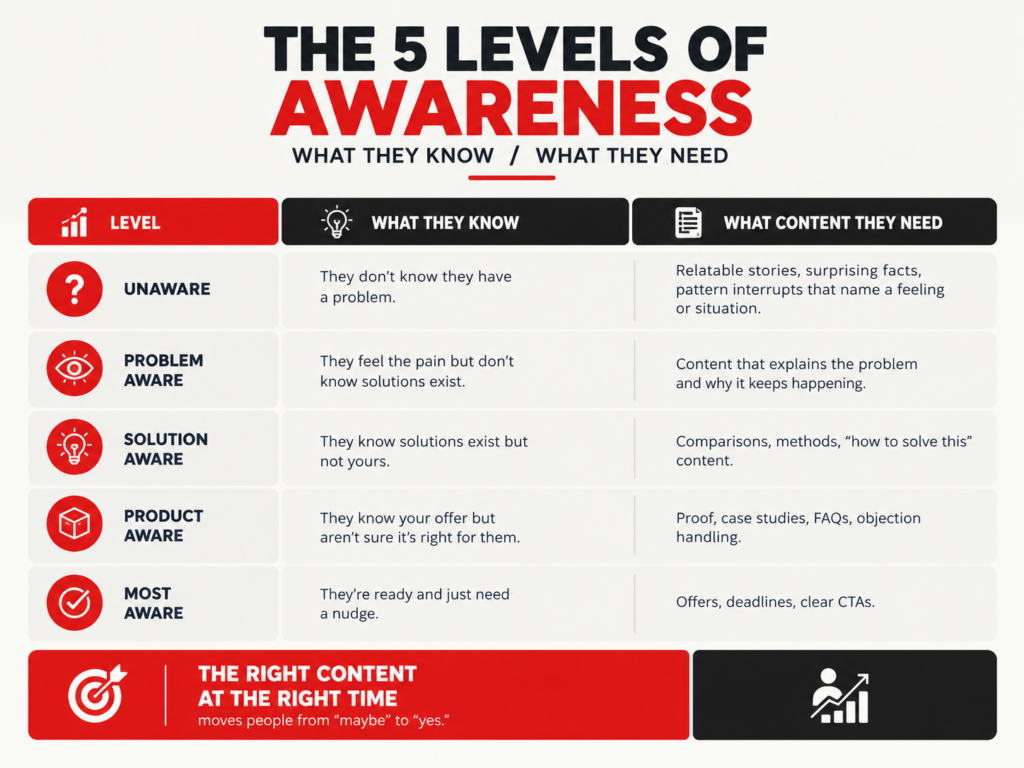
The rule is simple: speak to people at the level they’re on. Pitching your offer to someone who’s unaware is why most cold content fails.
The Simplest Content Marketing Funnel: TOFU, MOFU and BOFU
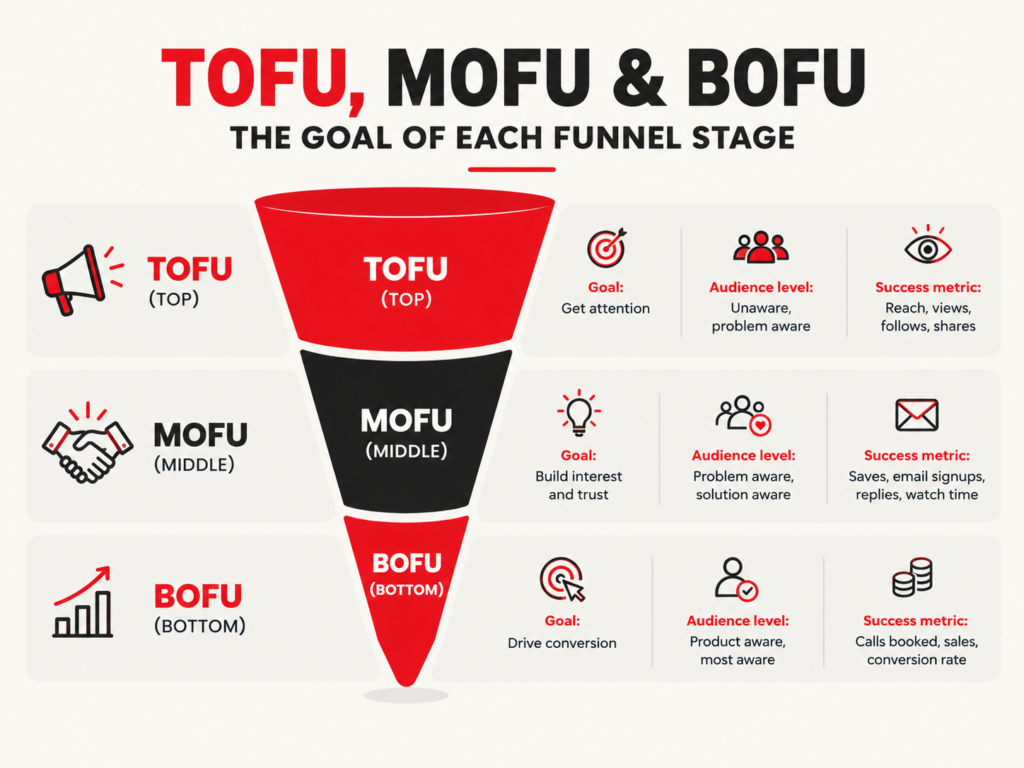
If all of this feels like a lot, TOFU, MOFU and BOFU is the easiest way to start. It groups the five awareness stages into three simple parts.
TOFU: Top Of Funnel
This stage includes people who do not know who you are. The goal is getting their attention without the need for selling anything. This type of content should be broad, relatable, and easily sharable, such as reels, carousels, and trending content.
MOFU: Middle Of Funnel
In this stage of the content marketing funnel, people know about your existence and they are interested in your business or service. It is meant to develop trust and establish credibility and show that you have what it takes to deliver your promises. Content here can be in the form of tutorials, success stories, lead magnets, and email campaigns.
BOFU: Bottom Of Funnel
People here are ready to buy. The objective is conversion. Content in this stage eliminates any last doubts, testimonials, offer breakdown, FAQ and a call-to-action.
Content Marketing Funnel Example: A 1 on 1 Program to Get Jacked in 6 Months
Imagine you’re a fitness coach selling a 1 on 1 program that helps people build muscle in 6 months. Here’s how your audience breaks down and what content fits each stage.
- Unaware (TOFU): They don’t think about their physique as a problem. Use pattern interrupts like “You’ve trained for 2 years and still look like day one” to stop the scroll.
- Problem aware (TOFU): They feel stuck but don’t know why. Post Reels like “Why you’re not building muscle even though you train 5 days a week.”
- Solution aware (MOFU): They’re comparing apps, gym plans and coaches. Share comparisons like “Online workout apps vs a 1 on 1 coach” and your own training method.
- Product aware (BOFU): They’ve seen your program but are unsure. Post client transformation stories, FAQs and answers to “I don’t have time” or “I’ve failed before.”
- Most aware (BOFU): They’re ready. Announce limited spots with a clear call to action like “Apply for 1 of 5 spots this month.”
One viral post will not sells your program. But a chain of content that guides a cold viewer step by step until booking a call feels like the obvious next move by following a content marketing funnel will.
Other Content Marketing Funnel Frameworks
TOFU, MOFU and BOFU isn’t the only model. Here are two more you’ll often come across.
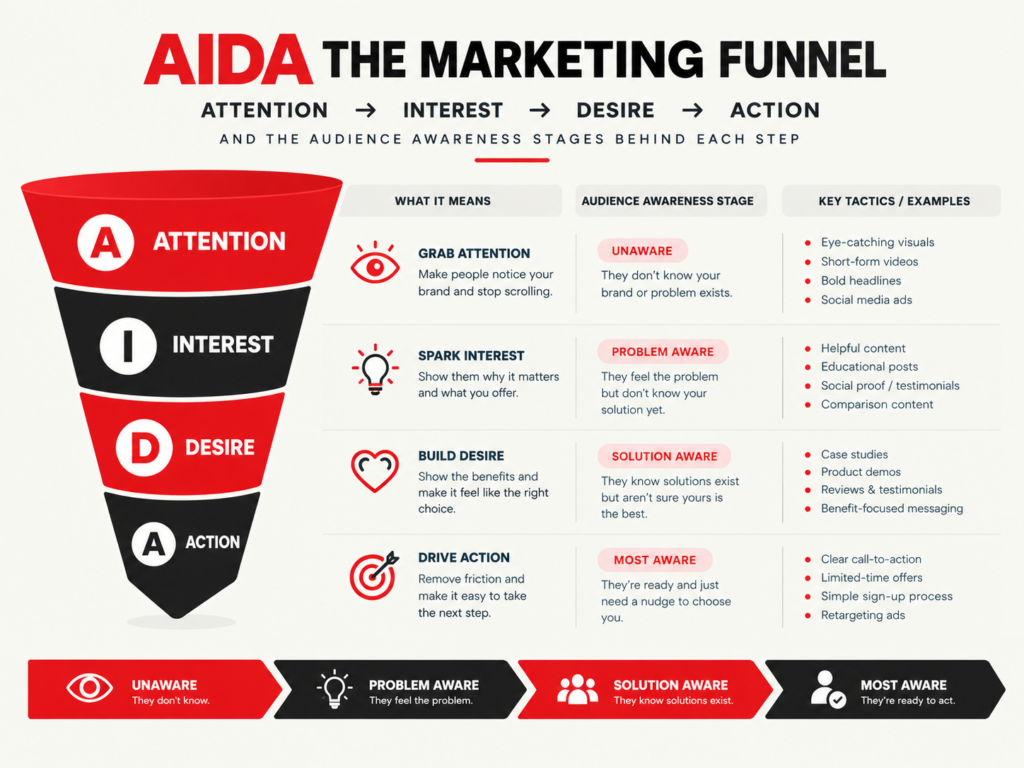
AIDA (Attention, Interest, Desire, Action)–
This classic framework describes the mental steps a person takes before buying. You grab their attention, build interest by showing relevance, create desire by showing the result they’ll get and finish with a clear action. It works well for single posts, Reels, emails and ads.
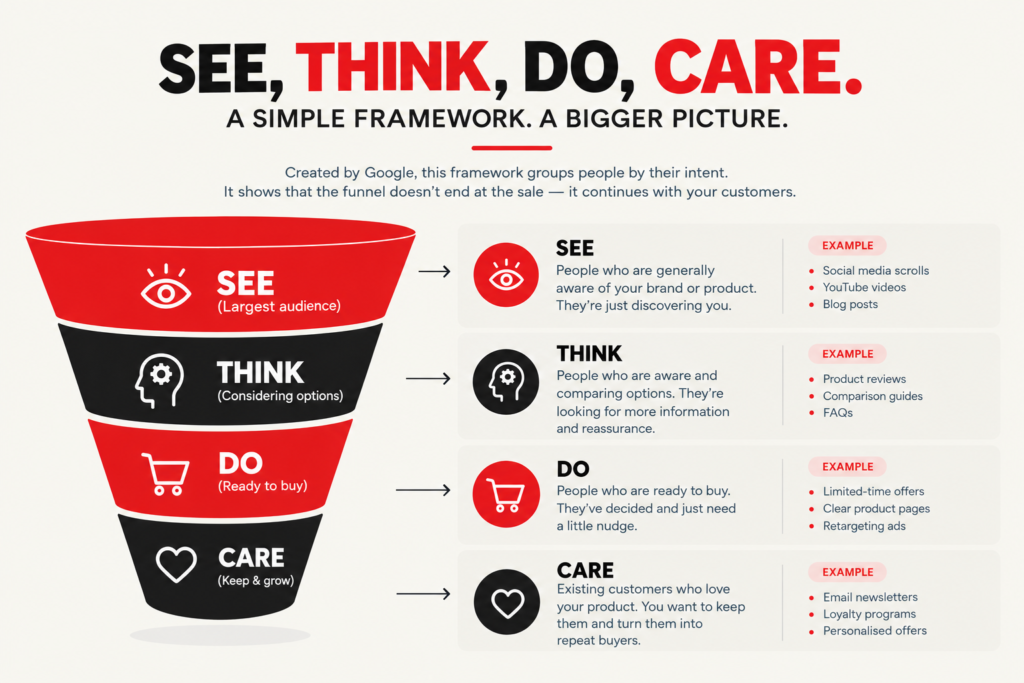
See, Think, Do, Care-
Created by Google, this framework groups people by their intent. “See” is the widest audience with general interest, “Think” is people considering options, “Do” is people ready to buy and “Care” is existing customers you want to keep and turn into repeat buyers. Its fourth stage is what makes it different, because it reminds you that the funnel doesn’t end at the sale.
Every Content Marketing Funnel Works the Same Way
Look closely and you’ll notice that these frameworks aren’t all that different. They all do the same thing: figure out where the potential customer is in their awareness stage and give them the content they react to.
If it feels confusing, don’t worry. You don’t need to memorize every framework. Focus on TOFU, MOFU and BOFU, because it’s the simplest and it covers everything you need to build a content marketing funnel that works.
Want to grow your business on social media, increase your reach and get more customers without spending a single cent? Read this guide on organic social media marketing.
Check out my Website for more blogs like this that help you grow your business.